Posts

Scrum Talk by Ken Schwaber

This is a Scrum talk by Ken Schwaber. It is published on Google Tech Talks.

Book Review Webcast: The Logical Thinking Process

Making a webcast requires a bit more work than writing a review. On the other hand, its fun, and the review just might reach more people. Let's see how it plays out.

Mutual Benefit Contracts

This post is in response to a question about contracts in a comment to my article The Customer Drives the Car . The text is an excerpt from a book I am writing about Clarity, a software development method based on systems thinking. This book is on the back burner at the moment.  I am currently writing a book about strategy and organization with Strategic Navigation. This book will stand on its own, but it will also provide a much needed framework for the Clarity book. The reason is that originally, Clarity, like other agile methodologies, took a bottoms up approach to methodology development. Partly because of my work on Clarity, partly because of my involvement with The Theory Of constraints, Strategic Navigation, and Systems Thinking, I have become convinced that a top down approach will work better. Therefore, Clarity will be redesigned, and thoroughly tested, before I publish a book about the method as a whole. Here is Clarity's (current) take on contracts: A contract is an ag...
Strategic Principles - Apple, iPhone and John Boyd's Maneuver Conflict

Time to scratch the webcast itch again. This time I am talking about principles of business strategy. Some time ago, I Googled out more about Apple's iPhone strategy. More than a million hits, yet I found nothing about the strategic principles Apple uses. As it turns out, almost every move Apple makes can be interpreted in terms of Maneuver Conflict, a military strategic doctrine created by the late col. John Boyd, U.S. Air Force. Boyd's ideas has had tremendous impact on military strategic thinking the past twenty years. His ideas are slowly trickling over into the business community. There will be more videos on Boyd's ideas, and on Strategic Navigation, a business strategy method that combines Boyd's Maneuver Conflict and The Theory Of Constraints.

Steve jobs Announces iPhone 3G

Steve jobs has just announced iPhone 3G at WWDC 2008. The new iPhone has 3G and GPS. Standby time has been improved to 300 hours. Talk time is up to 10 hours with 2G, 5 hours with 3G. You can expect to watch video for 7 hours, or listen to audio 24 hours on a charge. Price has been cut to $199 for the 8GB model and $299 for the 16GB model. Why am I interested? I have taken an interest in Apple lately. Working on a webcast on business strategy with Apple and iPhone examples. Check back here in a day or two.

One More OODA Loop Through the IOHAI Hoop

Image
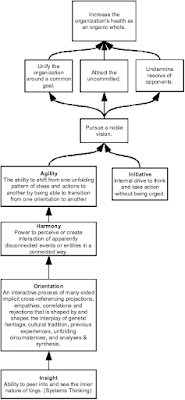
In a previous article I wrote about IOHAI - John Boyd's leadership model. I used Intermediate Objective maps to deconstruct IOHAI in a manner consistent with the ideas in Boyd's essay Destruction & Creation. A friend told me it was the most incomprehensible essay I had ever written. I regard that as a challenge to make one more OODA loop through the IOHAI hoop. (Though I should warn you I write to comprehend, not to be comprehended.) In the previous article I mentioned there was another way to decontruct IOHAI. Actually, there is an infinity of ways. Here is one, created under the assumption that Orientation means "good Orientation". Under that assumption, Insight becomes a prerequisite for Orientation. I have also made Orientation a prerequisite for Harmony. We cannot achieve Harmony if we are no good at Orienting ourselves: Now let's look at Initiative, hanging there all by itself. Initiative is a personal property. Some people have more, others have less. I...

Mission Statements Ackording to Dr. Ackoff and John Boyd

I just read an article about mission statements by Dr. Russel Ackoff. The article is old, but Ackoffs views are certainly worth thinking about. Compare with Boyd (Patterns of Conflict, slide 144): Unifying vision A grand ideal, overarching theme, or noble philosophy that represents a coherent paradigm within which individuals as well as societies can shape and adapt to unfolding circumstances—yet offers a way to expose flaws of competing or adversary systems. Looks like we can take elements from Dr. Ackoff's article, and use it to better understand what Boyd meant. Or, we can use Boyd's ideas about organization in order to understand the importance and relevance of Dr. Ackoff's ideas about mission statements. Deconstructing again, and I haven't even drunk any coffee today.

Deconstructing IOHAI

Image
In 1976 John Boyd wrote a famous essay, Destruction & Creation. The essay is essentially about how creativity works. Boyd's idea was that a body of knowledge in the human mind can be likened to an island consisting of connected information. Creativity is the process of destroying the connections between the pieces of information, and constructing new patterns by assembling the knowledge in different ways. Sometimes we just break a single body of knowledge apart, and reassemble it again. Sometimes we insert pieces of information from other bodies of knowledge. This process of de struction and construction of patterns of knowledge is sometimes called analysis and synthesis , but there is a simpler word: deconstruction . (In case this article gets too heavy, check out the Babylon 5 episode The Deconstruction of Falling Stars .) Boyd deconstructed military strategy in his Discourse on Winning and Losing . (Scroll about half-way down the web page to find the Discourse.) Of course, ...

Knowledge Associates

I do not advertise much in this blog, not even my own services. Sometimes I make exceptions though: Knowledge Associates is a new Theory Of Constraints consultancy in Victoria, Australia. If you live in the neighborhood (i.e. the Southern Hemisphere), and want a problem solved in your organization, why not talk to them? They might be able to help. They certainly do have an attractive offer . While on the subject of advertising, if you live in the Northern hemisphere and want a similarly attractive offer, there is only one place to go that I know of. And now back to our regular programming.

IO map for Strategic Methods

Image
The IO map above describes the Necessary Conditions that must be fulfilled in order to have an organization that can create and execute strategy effectively in a fast changing environment. The idea isn't mine. Originally it is Colonel John Boyd's idea. William Dettmer translated Boyd's Maneuver Warfare into a civilian version, Strategic Navigation . I have added some of the obstacles (hexagons) that an organization must overcome in order to create and execute strategy effectively. The map is interesting both because it explains what it is that makes Strategic Navigation and Maneuver Warfare effective, and because it provides a simple way of evaluating any strategic method. If the necessary conditions aren't fulfilled, then the method, even though it may have great strengths, also has weaknesses that will keep it from being as effective as it should be. You may have read critical studies that show strategic methods often do not work. Boyd worked out why some methods do w...

One Revolution Through the OODA Loop

Image
Our environment shapes our actions in ways that are not obvious, until we make a conscious effort to step outside the box. You will probably agree that it is plausible that our experiences and our environment influences the strategic choices we make. Sounds reasonable, even if it is a rather generic statement. There is a strategic model that incorporates this idea, the OODA loop . Look and behold the OODA loop in all its gory complexity: The OODA loop is originally a military strategic concept created by U.S. Air Force Colonel John Boyd. Some experts consider Boyd to be the greatest military genius of the past two thousand years. Like Sun Tzu and Musashi, his ideas have been applied to business strategy as well as military strategy. Boyd developed a strategic model that is called Maneuver Warfare. (Boyd did not use this name himself. He called it Maneuver Conflict.) The OODA loop isn't prescriptive in the way the PDCA/PDSA, TOC Focusing Steps, or Test-Driven Design loops are prescr...

IO Map for Process Design

Image
I had reason to think about how to design processes recently, and just for fun I drew the Intermediate Objective map you see above. This is a process level IO map. It shows the necessary conditions that must be fulfilled in order to have a good process design. The map is meant to be generic, so you may have to adapt it to fit a special situation. In most cases, it can be used as is. Note though, that one of the necessary conditions for creating a good process is understanding how the goal of the process furthers the goal of the organization using the process. In other words, you need an IO map for the organization (or equivalent) in order to create a good process. I won't write a long-winded article with a detailed explanation of the map, at least not for now. However, if you have any questions, don't hesitate to ask.

Powers of Observation

Frank Patrick showed this little gem:

Change Or Die

Larry Leach pointed to an interesting article about behavior change in individuals and organizations in the CriticalChain group at Yahoo. According to the article, medical research shows nine people out of ten would rather die than change their behavior. In other words, scaring people into eating less junk food, quit smoking and drinking, and exercising more has only a 10% success rate. On the other hand, with positive reinforcement, 77% will change.

Minds On Fire

You might wish to read this article, by John Seely Brown and Richard Adler, on how we learn. It has sparked a lot of discussion in the blogosphere. Here is a quote: Compelling evidence for the importance of social interaction to learning comes from the landmark study by Richard J. Light, of the Harvard Graduate School of Education, of students’ college/university experience. Light discovered that one of the strongest determinants of students’ success in higher education—more important than the details of their instructors’ teaching styles—was their ability to form or participate in small study groups. Students who studied in groups, even only once a week, were more engaged in their studies, were better prepared for class, and learned significantly more than students who worked on their own. 6 The emphasis on social learning stands in sharp contrast to the traditional Cartesian view of knowledge and learning—a view that has largely dominated the way education has been structured for o...

Choice - Peace On Streets

Clarke Ching blogged about the video above. You can also find it on Youtube . I am really glad I live in a country where this is less of a problem than it is in many other places in the world.

Business Value

Image
Managers like to talk about business value. It usually goes like this: A group of managers sit around a table. It may be in a conference room, around a dinner table, or in a bar. "We must offer more business value," one of them says. Everyone nods in agreement. Then it grows silent. Uncomfortable. Everyone carefully avoids looking directly at anyone else. Finally, someone breaks the silence: "Anything interesting on TV tonight?" Agile software developers caught on to the notion of delivering business value several years ago. As a result, software developers now have the same sort of dead end conversations about business value their managers have, with the same result. I have played this little game myself upon occasion, both as part owner of a consultancy, and as a developer. It always played out the same way. I was reminded about this today when I read an InfoQ article about business value. The article quoted extensively from an article by Joe Little, Toward A Gen...

The Graph That Got Away

Image
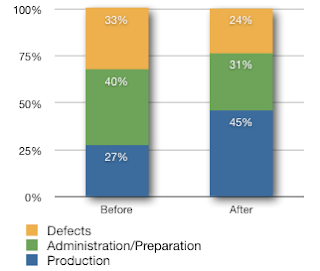
I have been thinking a lot about how to present information about agile and TOC improvement efforts lately. Last night I had a look at some old process data, and had the opportunity to reflect upon a route I didn't take at the time I was involved in the improvement project. The project was switching from traditional RUP-based development to Scrum (with a healthy dose of TOC). At the time I collected the data, from an andon (Kanban board) I had helped a development team set up, the top priority was finding and exploiting bottlenecks in the process. The second priority was reducing inventory (Design-In-Process). Therefore I focused on Throughput and DIP. That was the right decision under the circumstances, and it did work. The manager I worked for had experience with Lean, and had no problem understanding what the development team and I was doing. That particular manager did not need my assistance in explaining what was happening to other managers, but what if he had? Is there som...

Ron Davison's Systems Thinking Webcasts

If you are interested in systems thinking, you might want to watch Ron Davison's webcasts . I haven't viewed the whole series yet, but what I have seen is interesting.

How Organizations Change, Part 3: Drive Out Fear

I have just released part three in the How Organizations Change series. I decided to split the material into more digestible chunks, so I discuss only one of the root causes that make it difficult for organizations to learn and adapt: fear. The webcast contains material from a ZDNet Australia interview with Lloyd Taylor, VP of Operations at LinkedIn. I would like to thank Brian Haverty, Editorial Director of CNet Australia for permission to use the interview. The full interview is available at http://www.zdnet.com.au/insight/soa/LinkedIn-Lloyd-Taylor- VP-of-Technical-Operations/0,139023731,339285616,00.htm The webcast also contains an excerpt from the A Day with Dr. Russell L. Ackoff conference at JudgeLink. I would like to thank Dr. Ackoff for his kind permission to use the material in my webcast. Dr. Ackoff's talk at the conference was inspired, to say the least. You can view it all at http://www.judgelink.org/Presentations/GirlsLink/index.html .