Posts

Fixes That Fail

Image
Many companies use a standard response in troubled times, they appoint a new CEO. The new CEO takes measures. If the CEO is a former sales person, he focuses on improving sales. If the CEO is a former accountant, there will be a savings program. A CEO with a technical background will focus on developing new products. The outcome is usually one of the following: The company takes a nosedive, crashes and burns. Nothing happens. The gradual decline continues. Eventually yet another CEO is appointed. There is improvement. Sometimes the improvement is radical. after awhile, the rate of improvement abates. Then the company begins to backslide. Eventually another CEO is appointed. There is a sustained improvement in the company's financial health. This is rare though. The third alternative, initial success followed by backsliding, is in many ways the most interesting outcome. First of all it is a common outcome. Second, it often seems inexplicable. The CEO proved his management genius...

Truth, Damned Truth, and Statistics, Part 2

Image
This is part 2 in a series of articles. You can read the first part if you click here . In the previous article in this series, I discussed how to measure and visualize the Throughput part of the Return On Investment (ROI) equation. This time I'll focus on Inventory (I). As you may recall, Inventory is defined as "money tied up in the system". Inventory includes all the equipment you use in a development project, computers, software, chairs, tables, etc. In a manufacturing process, Inventory would also include the partially finished material being worked on in the process itself, the Work-In-Progress, or WIP. In a software development process there is no WIP, but there is an analog: partially finished software. This includes requirements, design specifications, and any code that is not fully finished, tested, and ready for release. Partially finished software is sometimes called Design-In-Progress, or DIP. The DIP has a monetary value. The value of the DIP is the amount o...

Five Things Managers (Usually) Don't Get About Agile

Clash 1: Goals Traditional development methods set three goals: Keep within budget Implement all requirements (often specified before the project starts) Make the deadline Agile projects set the following goal: Maximize the Return On Investment (ROI) To maximize the ROI, an agile project changes the following variables: Cost Scope Time In other words, what traditional software development, and most companies, set as fixed goals, are just the things an agile project need to change to reach its goal. Clash 2: Push vs. Pull Another major difference is that most companies, and traditional development methods, are based on push systems, while agile is based on pull systems. : In a push system , each step in a production line does what the previous step tells it to do. In a pull system , each step in a production line does what the following step has to do. The situation when orders start travelling from both ends of the command chain can at best be described as chaotic. Clash 3: Cost Effi...

www.henrikmartensson.org is Down, but Kallokain is Up

As you may have noticed www.henrikmartensson.org has been down for some time. The site went down because some of the software broke when the host system was upgraded. Before putting the system up again, I will fix some broken links and other problems. My schedule is rather full these days, mostly with the joys of fatherhood, but also with a major writing project, and a few other things, so getting the site going again will take some time. I will spend time blogging again though. The past few months have been incredibly hectic, but the past few weeks my life has settled down to a somewhat saner pace. Besides, my writing addiction is stronger than ever.

Truth, Damned Truth, and Statistics

Image
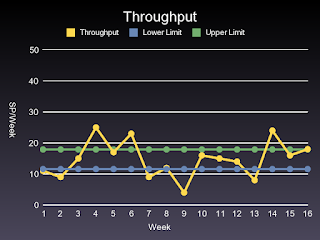
Statistics may not be what floats your boat, but statistics can tell some important things about software development projects. In this article, I'll show how even a very simple analysis of some basic project measurements can be exceedingly useful. The data in the following analysis is fake, but the situations they describe are from real projects. A commercial software development project is a system that turns requirements into money. Therefore it makes sense to use economic measures, at least for a birds eye view of a project. If you have read my earlier postings, you will be familiar with the basic equation describing the state of a business system, the Return On Investment (ROI) equation: ROI = (T - OE) / I T = Throughput, the rate at which the project generates money. Because it is hard to put a monetary value on each unit of client valued functionality, this is commonly measured in Story Points, Function Points, or Feature Descriptions instead. I'll use Story Points, beca...

The Big DIP

Lately, I have had reason to study the effects that Design-In-Process, DIP, has on the profitability of software projects. It turns out DIP is a project killer, and potentially a corporate business killer too. What is Design-In-Process? It is partially finished work. Most software development projects have too much of it. The manufacturing industry learned decades ago that too much inventory was a bad thing. In the software development business, the inventory is Design-In-Process. We still haven't learned the lesson. Why is DIP bad? Let's have a look at the classic Return On Investment (ROI) equation: ROI = (T - OE) / I Where: ROI is the Return On Investment, a measure of how profitable a business system (company, project, etc.) is T is Throughput, the amount of money made OE is Operating Expenses, the money the business system spends producing throughput. Wages, rent, electricity, are all OE. I is investment, the money tied up in the system. This includes computers...

Traffic Simulator

While looking for material about queue theory, I came across a traffic simulator that is worth a look. With it, you can simulate how traffic moves, and doesn't move, in different kinds of situations. It is worth a look.

Scrumming

Image
I have begun working in a new project recently. It is the first Scrum project at Wireless Car, and they hired Tobias Fors from Citerus to get us started. Tobias presented Scrum in a manner that was both entertaining and informative. The kick-off took two days. The first day was a Scrum presentation, the second day we did Sprint planning. It is rare to meet someone that can talk about the same subject matter for two days straight without being boring even once. I usually make people's eyes glaze over within a few minutes, so I was very impressed with Tobias. Also, for two days I had someone new to talk about agile and TOC and queue theory with. Great!

The Gothenburg Ruby User Group, 2nd Meeting

Image
I missed the first Gothenburg Ruby User Group (GRUG) meeting, but not the second, last Thursaday evening. 15 geeks (only a few of whom are shown in the picture), and Ruby. Doesn't get much better. Niclas Nilsson and Karl-Johan Kihlbom talked about the recent RailsConf conference in London. The main event, arranged by Emily Bache, was a code kata. You can read more about it in the GRUG Google Group at http://groups.google.com/group/grug . The next meeting will be in a month or so. I'm looking forward to it already.

Flow vs. Function

I have written a presentation comparing flow organizations and functional organizations. You can check it out here if you are interested in this sort of thing.

Systems Thinking: Five-Why

In the Systems Thinking series of posts (also including Systems Archetype: Shifting the Burden and Systems Archetype: Shifting the Burden to the Intervenor ), I try to show the basics of how complex business systems interact. With the systems archetypes, it is possible to find standard solutions to common problems, but there is still a piece missing. In a specific case, how do you find the root cause to your problem? Have you ever worked in a project, or workplace, where it feels as if you are spending all your time fighting little fires? Usually, all those little fires stem from a few root causes. Unless you want to spend your time fire-fighting, you had better find the root cause of your problems, and deal with that. There are many methods of finding root causes. One of my favorites, because it is so simple, is Toyota's Five-Why method. The idea is that when you are faced with a problem, you ask why that problem occurred. When you find the thing that caused your problem, you as...

Going With the Flow

So, maybe it's not a full month. Then again, I'm not really back. I am writing this in an Internet cafe in Ho Chi Minh City, Vietnam. If you want to study one-piece-flow, and want to see why moving small batches around is better than lugging large ones, HCMC is the perfect place. The streets here have more traffic than anything I've ever seen. There are very few traffic lights, and driving on the right side of the road is sort of a very loose agreement. Also, the most common vehicles are scooters and light motorcycles. There are 30 million scooters in Vietnam, and by the look of it, most of them drive by my hotel each day. (I'll upload some pictures when I get back.) One would expect the result to be total chaos and confusion. It isn't! Actually, the traffic flows like nothing you've ever seen (unless you've been here, of course). There are two reasons for this. The first is that though the streets are packed with vehicles, each vehicle is small and manouver...

I'm Taking a Month Off

I'm taking a month off from blogging. Will be back in September.

Systems Archetype: Shifting the Burden to the Intervenor

Image
There is a special case of Shifting the Burden which I am especially familiar with because I have worked as a consultant for many years: Shifting the Burden to the Intervenor . Description The problem may occur when an organization decides to rely on outside competence to solve an internal problem. The problem may be solved. The catch is that the competence to deal with the internal problem now resides outside the organization. This makes the organization vulnerable if the problem occurs again. "The organization" may be a company that outsources development work to a consultant, or outsources a part of their infrastructure to a subcontractor. Departments within an organization are also vulnerable. They may (not always voluntarily) let another part of the organization take over an important function, only to find that the other part of the organization is not able to process requests quickly (usually because of queues), may not fully understand the requests (development depar...

Systems Archetype: Shifting the Burden

Image
Description Shifting the Burden is one of the more common systems archetypes. The problem occurs when a short term fix is applied without regards for possible side effects. The short term fix seems to work, but over time the side effects escalate. In many cases, the capability to apply a long term solution atrophy over time, making it very hard to correct the problem. Example A classic Shifting the Burden example in software development is when management tries to apply a brute force solution, like increasing the manpower of a project, or forcing developers to work an excessive amount of overtime, to compensate for low productivity, or poor planning. The diagram above describes a situation where a project has productivity problems. In other words, it won't make the deadline. The obvious, but often flawed, solution is to add more people to the project. Most projects measure progress in terms of hours worked. Unless you live on Mars, you are almost certainly familiar with the basic ...

Systems Thinking

Image
Systems thinking is a theory that argues that social systems must be studied as a whole. It is impossible to predict the effects of the whole system by studying its parts in isolation. A "social system" can be anything from a family unit, to a system of interacting economic units (companies, countries, etc.), or even an ecological system. Systems thinking is an important part of the theoretical foundation for agile software development methodologies. I got interested in it some years ago because I kept stumbling on references to the systems thinking bible, The Fifth Discipline , by Peter M. Senge, in books about agile methodologies. Somehow, there was always one more programming book to buy first, but then I spied a copy at my parents-in-law's house, and borrowed it. After a few pages, I was hooked. Since then, I have worked systems thinking into the way I work. I have found it to be a valuable tool when trying to figure out what is really happening in different situation...

A Manager's Mind is a Strange Place

A while ago (in another company than the one I work for now) I worked for a company that did not believe in making things easy for their developers. Everyone had to work in an open landscape. The landscape was divided into rectangular cells. Developers sat at corner desks, so that developers in a cell faced away from each other. To make communication between developers even more difficult, people working on the same project were usually located in different cells. A new and very complicated project began. We developers realized that the seating arrangements would never work. There was no way we could succeed if we could not talk to each other. We decided to ask our department manager for a project room of our own. The department manager realized that we needed to work close by to have the slightest chance of success. "OK," he said, "you'll get the room, for this project, because it is an unusually difficult one, but of course you can't get one every time you need...

The Variance Trap Images and Animations are Back

A couple of people have emailed me about missing images and animations in my Variance Trap series of postings. The broken links were due to a reorganization of my web site. I have finally fixed the problem. You can view the postings here: Part 1 , Part 2 , Part 3 , Part 4 , Part 5 .

Forthcoming: Pro Ruby

Apress has listed a new Ruby book, Pro Ruby , among its forthcoming titles. Pro Ruby shows how to combine Ruby and agile methodologies into a unified, powerful package. I do have a special interest in this book, because I'm writing it. (Which is why I have blogged less than usual lately.) I don't want to give anything away prematurely, but I can tell you two things about the book: It does not have a Hello World example There is a sample application, but it isn't an online shopping application There will be some time before Pro Ruby hits the book stores. When it does, I hope you like it.

The Daily WTF

This site is too good to miss: http://thedailywtf.com/