Posts

Dave Snowden's Keynote at XP 2012, Part 2 of 2

Image
This is part two of Dave Snowden's keynote. Great stuff.   Part 1 is here .

Dave Snowden's Keynote at XP2012, Part 1 of 2

Image
Dave Snowden talks about complexity thinking and contrasts it with design thinking and systems thinking in his XP 2012 keynote. This is one keynote worth listening to. I was very fortunate to get it all on video. Part 2 is here .

LESS! is released!

Image
Whew! After six months of hard work, LESS!: Essays on Business Transformation is released. I should write something brilliant about this, but I just feel tired and happy. I'll go play with my son instead. I have deserved it, and so has he. Just one thing: You may recall an earlier cover picture: You may notice that the cover has changed slightly compared to the earlier version: John Hagel III  has written an excellent Foreword. Check him out. I am immensely proud that he wanted to do that for us. John is a great management writer. He is also Co-chairman of the Deloitte Center for the Edge, and Director Deloitte Consulting LLP. I am currently reading his latest book, The Power of Pull . Chances are you already do know about some of the LESS! authors, but I'll give you a list with links so you can have a look: Dan Bergh Johnsson  - Technology evangelist and blogger Bjarte Bogsnes  - Chairman of the Beyond Budgeting Roundtable Europe Peter Bunce  - ...

Agile Company Presentation at XP 2012

Image
It nearly did no happen because of my workload, but I will go to XP 2012. Here is a brief description of my presentation: Agile Company - Win by doing LESS! Over the past 50 years there have been many attempts to change how business organizations work: BPR, Deming's System of Profound Knowledge, McGregor's Human Enterprise, de Geus Living Company, Semler's Three Ring Model, Theory of Constraints... Despite great initial success, all these initiatives have failed. Now Lean and Agile show signs of failing, for the same reason their predecessors failed. The problem is that when a small system, like an Agile team, tries to change a large system, like a company and its customers, through long and continuous contact, the small system will change much more than the large system. This is also known as  Prescott's Pickle Principle : Cucumbers get more pickled than brine gets cucumbered Can Agile and Lean avoid getting pickled the same way they pr...

Writing LESS!

Image
The LESS! book cover and the first four chapters. The LESS! book is close to completion. All chapters are in, I have edited more than two thirds of the book. This has been my most enjoyable writing project in a very long time. Writing a book always requires a lot of hard work, but it is also incredibly fun. If you work with great people, which I do, the fun factor goes up...way, way, up! I have wanted to write a collaborative management book for a couple of years now, but when I got the opportunity, I was not the first to recognize it. Katherine Kirk did! Katherine and I were both speakers at the LESS 2011 management conference. The conference was a blast. Lots of great speakers: smart, experienced, deep thinkers, and very good at presenting their ideas. I decided to take the opportunity to interview a few of them for a book project that had been on the back burner for a year. I hadn't written much for awhile, and I was really itching to write and publish a new book. Kat...

iBook Author – Apple Changes the Game Again!

Image
The latest game changer from Apple is a bit sneaky. Apple recently launched iBooks Author, an eBook authoring tool. There were ads in the App Store of course, but overall, not much fanfare. Nevertheless, iBook Author is an important move. Amazon needs to watch out, or Apple will grab a sizable chunk of the eBook market. Why is iBooks author important? iBooks Author puts Apple in direct contact with authors, bypassing a traditional obstacle to publishing, publishing companies. A traditional publishing flow looks like this: Apple cuts out the people in the middle, like this: Publishing becomes easier, faster and cheaper than before. By itself, this would not be a decisive advantage. Amazon has 90% of the eBook market, and they aim to keep it. However, Apple has another little innovation up its sleeve: the iBooks Author workflow. It looks like this: An author can work directly in iBooks Author, write an eBook, integrating text, video, audio, presentations, even 3D objec...

Viva la Pasta! - Spaghetti Management

Image
Bo Hagström is a well known chef, and hosts Sun Food (Swedish: Solens Mat), a Swedish TV show. I met Bo when he signed books in a bookstore. His latest book, Viva la Pasta! is about, you guessed it, pasta! Bo is on a mission: He wants to teach Swedes about pasta. As it turned out, with good reason. I got a short but interesting lesson. Bo handed me two strands of pasta and asked me to feel them. One strand was very straight, and felt completely smooth. The other strand was different, slightly crooked. The surface felt slightly rough. The straight, smooth strand is bad pasta, Bo told me. It is low on nutrients. It does not taste very good either. Because of the smooth surface, it does not absorb flavors from other ingredients. The slightly crooked strand with the rough surface is great pasta. Much more nutritious. Because it is porous, it can absorb flavors from sauce and other ingredients. The two kinds of pasta cost the same in the store. The bad pasta outsells the good...

Beyond Budgeting - Fixing the Budget Mess

Image
The audience at LESS 2011 conference was fantastic. Interested, educated, bright, and enthusiastic. Great people to meet and speak with. The chief cause of problems is solutions. –Eric Sevareid At the LESS 2011 conference an entire track was dedicated to solving the problems caused by the annual budgeting systems most organizations use. Yes, caused ! We have used annual budgeting for a long time. This means annual budgeting was created to solve problems in a world quite different from ours: The world moved slower, in more predictable cycles. Today, the world changes very quickly, and is a lot more unpredictable. This is not a bad thing per se. You can turn it to your advantage (which is what I talked about at the conference), but doing that while hanging on to an antiquated economic model is very difficult, to say the least. Does this sound familiar: " Great idea, but we can't do it right now. Let's wait for next year's budget. " The great idea will be ...

Survival – The Reason I am going to LESS 2011

Image
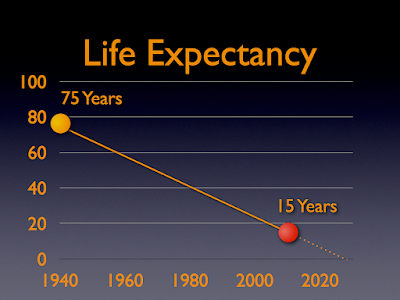
There are plenty of good reasons to go to the LESS 2011 management conference . Most of them have to do with fun–not clowning around fun (which has its merits)–but with the doing-meaningful-work and living a life of purpose kind of fun. However, there is another reason: Survival! According to John Hagell III , in 1937 the average life expectancy of a Standards & Poor Fortune 500 company was 75 years. Today, it is about 15 years. Let's be a little bit simplistic about this, and draw a straight line between the two data points. Then let's be a bit adventurous, and extrapolate into the future. If this simple projection holds, by 2030, there won't be any S&P Fortune 500 companies. I am sure you can see the flaws in this simple model as well as I can: There are only two data points. It is very easy to draw the wrong conclusions when using to few data points. (Though many companies are perfectly happy to use a single data point, which enables them to interpret i...

Tim Morrison at the Halmstad City Library

Image
Tim Morrison at the Halmstad City Library Tim Morrison played at the Halmstad City Library tonight. I had been sitting there working, most of the day. Luckily, I decided to stay a bit later than usual. I have no idea how to write about music, so I won't. Instead, I'll suggest you check out Tim's band, The Manglers. You'll find some sample songs at The Mangler MySpace page . Tim and I talked a bit after the gig. I bought a CD, which I am listening to as I write this. When Tim talked about writing lyrics, I recognized what I experience when writing a book or working on a presentation. It never ceases to amaze me how things that are very different on the surface, can be very similar on a deeper level. Some people can't help horsing around... As you can see above, there were other things happening at the event. In all, a very enjoyable evening.

The Gothenburg Book Fair (A brief guide to mingling, Part 2)

Image
This post continues the networking story from A brief guide to mingling . I strongly recommend you read that post first, because in it, I describe why I network. Having that perspective is important. If you read   A brief guide to mingling , I think you will agree. I went to the Gothenburg Book Fair today. The book fair is a yearly event. I go to look for interesting books, and to meet interesting people. Let's dive right in and see what happened: Erik Lundh , a friend of mine, and I had agreed beforehand to meet at the fair. Anna Sigvardsson , the photographer I met at the mingle last week and I had also decided to meet and have a cup of coffee at the fair. When I arrived, I had plenty of time before meeting either Erik or Anna, so I did what everyone else at the fair does: I went looking for anything interesting that might catch my eye. Kersti Ingeborn works at the Mediapool's School Library Service Pretty soon I found myself talking to Kersti Ingeborn at th...

A Brief Guide to Mingling

Image
Anna Sigvardsson is a photographer. Martin Richards is an English language coach. Martin I know from before. He brought me to my first BNI business meeting a couple of years ago. Anna I met for the first time at the mingle, but we have both been BNI members, and have acquaintances in common. I was at a mingling event, Göteborgsminglet a couple of days ago. Such events have become an increasingly important way of meeting people and developing business relationships. I left the event with one solid lead and more than half a dozen meetings booked. This is a marked difference from the first mingling event I went to about two years ago. When I left that first mingle, I had an enormous stack of business cards, but didn't really know what to do with them. Last Thursday, I had a much smaller stack of cards, but I knew what to do. What is the difference between now and then? Mainly, me: My own expectations, my understanding of what an event like this is, and its purpose, have ch...

I promise to do LESS in 2011!

The LESS 2011 conference in Stockholm, October 30th to November 2nd, looks set to be a lot of fun. A highly inspirational and useful kind of fun. If you go, you get to see and listen to keynote speakers like Steve Denning, former director of knowledge management at the World Bank, and Bjarte Bogsnaes who head's Statoils Beyond Budgeting project. You can hear systems thinker Peter Middleton, and Shingo Prize winner James Sutton. LESS has four tracks: Beyond Budgeting , Complexity and Systems Thinking , Lean and Agile Product Development , and Transforming Organizations . Check out the speaker lists and the topics, and you will understand why this is an event I do not want to miss. There is a long list of interesting speakers. I'll mention only a few, and I'll not even try to be unbiased about it. Instead, I'll pick those with whom I have had some contact, via social networks or otherwise, over the years: Jurgen Appelo has a talk titled Complexity Thinking? Or Sys...

Fugue for Norepinephrine, Dopamine, and Oxytocin

Image
I have written before about two very different ideas of management, Theory X and Theory Y, and how they engender different organisational structures, and very different working environments. Most of what I, and others, have written about Theory X/Y, uses the model as a basis for exploring outwards, from the individual to the organization. I believe it is just as important to explore in the other direction, going inwards. There are several paths open to inwards exploration: psychology, philosophy, religion, ethics, but in this article, I’ll take a short but brisk walk along the path of neuroscience. Let's recap Theory X and Y very briefly: Theory X and Y represent endpoints on a spectrum of attitudes managers may have towards the people who work for them. Theory X says people are basically lazy and motivated by self-interest and external rewards only. According to Theory X, people will always seek to maximize the monetary rewards they get, and minimize the work they put in. ...

myLife with iPad

Image
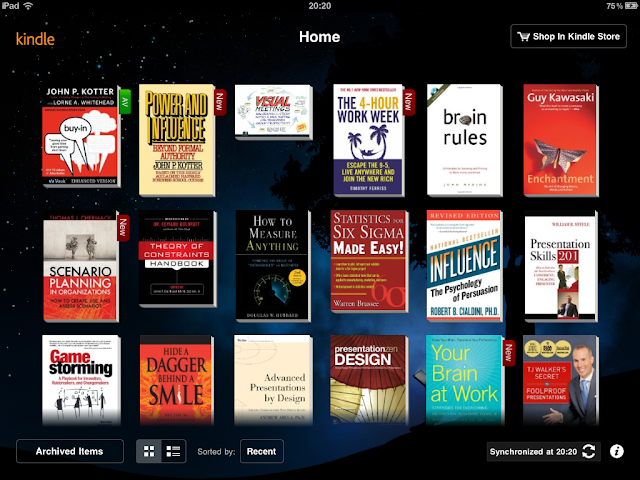
I bought an iPad 2 awhile ago. I am still working on figuring out why. Don't get me wrong, I had several reasons for buying it: I travel a lot while working. Before the iPad, I always had 4-6 books with me. I wanted to reduce the weight of my luggage, and bring more books. I read a lot, but I also want to bring my favorite reference books with me wherever I go. I want to use my time effectively, for example by reading email while on the go. I can do that on my phone, but I wanted a bit more convenience. My next book will be published as an eBook. I want to understand, I mean really grok, eBooks. I want to take full advantage of the medium. I was, and still am, curious. I wanted to know more about what an iPad is good for. Here is what I have found so far. I do read a lot of email, and browse the web, with my iPad, but I'll skip writing about that. Instead, I will focus on the other things that has made my working life easier the past few weeks. I've bought quite a f...

Talking Tempo! at McNeil

I had an opportunity to hold my Tempo!–Vision to Reality presentation at McNeil AB , makers of the Nicorette line of nicotine replacement therapy products. In short: Great audience, I got some very good questions, and there was an interesting discussion afterwards. A great day!

Talking Tempo! at FRR

Image
I used help from my audience to illustrate how changing the way we work can improve productivity while simultaneously reducing risk. Photo by Susanne Dahl. I held a Tempo! talk again. This time at Framgångsrika Relationer, FRR , a business network. This was (supposed to be) a short presentation so I focused on a single key topic: organizational design. You'd think that is a pretty dry topic, but it isn't. When you dive into why our companies are designed the way they are, it turns out that there is quite a bit of adventure involved: train crashes, dogfights between fighter pilots... Judging from the mail I get following these presentations, people like it. Everyone has their own experience of organizational inertia. It is a relief to get to know what causes it, that it is possible to get rid of much of it, and be happier in the process. Speaking of happiness: After each presentation, I get queries about where to buy Tempo! the book . Each time that happens, I know I ha...

Talking Tempo! at the University of Gothenburg School of Business, Economics, and Law Alumni Network

Image
We had lunch before the presentation. It was a great opportunity to speak with some of the alumni members. I've been talking Tempo! again. This time at th e  University of Gothenburg School of Business, Economics, and Law Alumni Network . It was great fun. The alumni network meets up two to four times a month at the university . They have lunch, and follow up with a guest presenter. Feeding the audience before a presentation is an excellent idea. As an added bonus, the presenter gets fed too, something I was in a position to appreciate very much. Bo Ribbenholt Presentations like these are often arranged through networks. A friend of mine, Joakim Olinder, whom I met through BNI, also knows Bo Ribbenholt of the alumni network. Joakim knew I look for opportunities to present, and he heard me talk about Tempo! at BNI World Trade Center in January. He contacted Bo and Bo contacted me. I won't spill the beans about the content of the presentation. If you read Swedish, you...